If you sell subscriptions and enforce order limits, there is one fact worth knowing before a customer finds it for you: the enforcement does not follow the subscription. It applies when the subscription is bought, and not to the orders it generates afterward.
What the documentation says
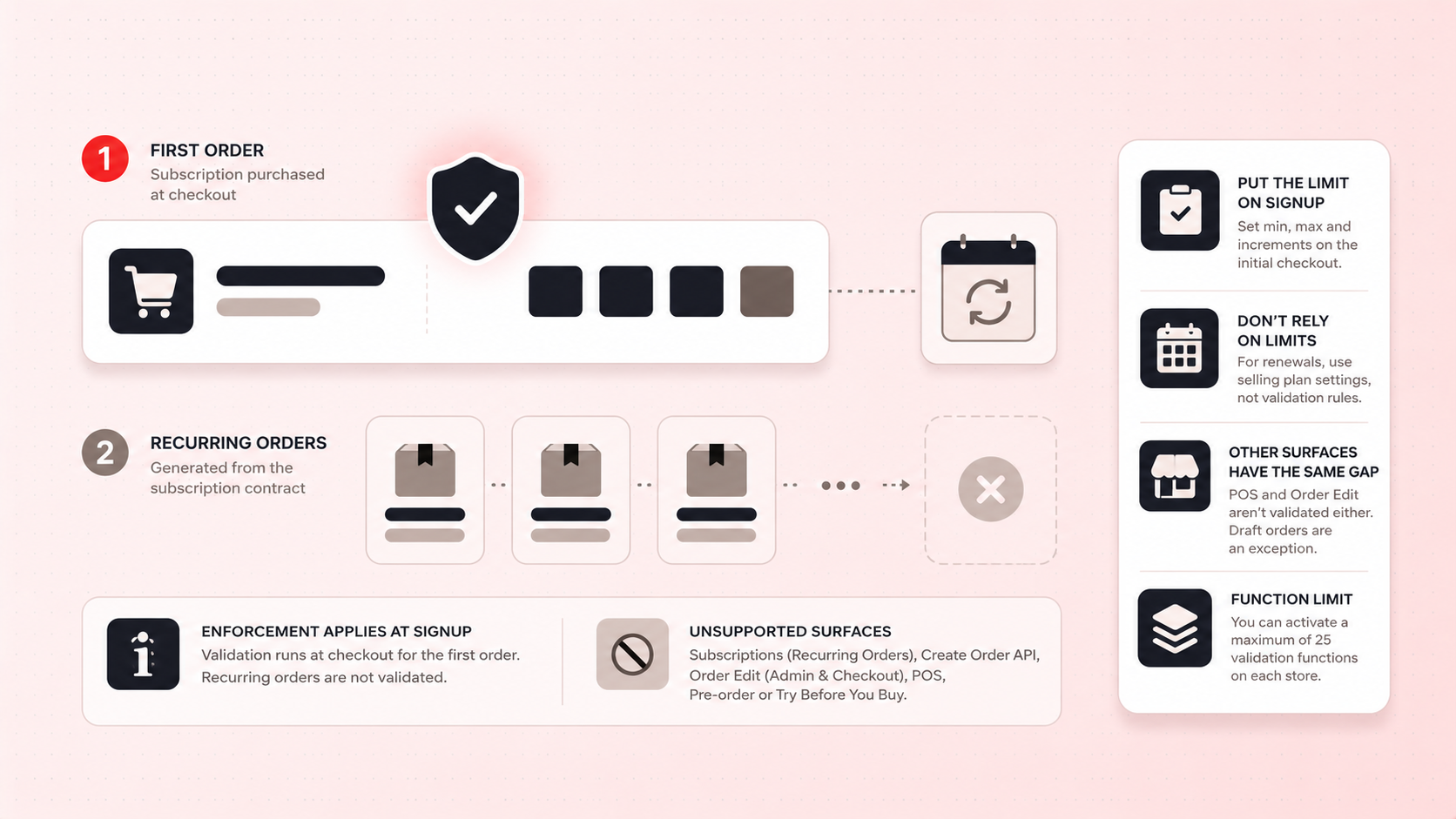
Shopify's Cart and Checkout Validation Function API reference lists surfaces where the API is not supported. That list includes Subscriptions (Recurring Orders), alongside the Create Order API, Order Edit in both the admin and checkout, POS, and Pre-order or Try Before You Buy.
So the shape is:
The first order is validated. A subscription is bought through checkout, and checkout is exactly where validation runs. Cart lines in the validation input carry a
sellingPlanAllocation, which describes how a variant can be sold and purchased, so a rule can see that a line is a subscription rather than a one-off.The recurring orders are not. Every order after the first is generated from the subscription contract, not assembled in a cart, and that surface is on the unsupported list.
Why this is not a bug
It is tempting to read the gap as an oversight. It is closer to a category difference. A recurring order is the fulfillment of an agreement the customer already made and you already accepted. Blocking it later would mean silently failing a contract, which is worse for the customer than never letting them sign it.
Which points to where the rule belongs: the moment of signup. If a subscription at that quantity would be unprofitable to ship every month, the place to say so is before the first payment, not on month four.
What to do with that
Put the limit on the signup. Minimums, maximums, and increments on the initial checkout are supported and are where the decision actually gets made.
Do not rely on a limit to police renewals. If a monthly quantity is a hard operational constraint, it belongs in the selling plan itself, not in a validation rule that will not run.
Watch the same gap on other surfaces. POS and Order Edit are on the same unsupported list, so an in-store sale or an edited order will not be held to your rule either. Draft orders are the exception worth knowing about: per the changelog of 11 December 2024, validation "runs in draft orders admin and checkout". We covered that in do order limits apply to draft orders.
One more ceiling to know about
The same reference notes that "you can activate a maximum of 25 validation functions on each store". That is generous for one app and worth remembering if you stack several apps that each install their own. Rules are cheap; function slots are finite.
How to verify this yourself
Do not take our word for it, and do not take a blog's. Open the API reference and read the unsupported list. It is the kind of detail that changes between versions, and the reference is dated and authoritative in a way that app marketing is not.