
Plenty of merchants sell wholesale without ever touching Shopify B2B. The buyer emails, you tag their account, and they order at trade prices through the same storefront. It works right up to the moment you need a minimum, because that is where the native feature sits behind a door you cannot open.
Where the native rules stop
Shopify does have proper quantity rules: a minimum, a maximum, and an increment per product or per variant, documented in Setting up quantity rules and volume pricing in B2B. They are a property of a B2B catalog, and the Help Centre notes that "Shopify B2B features are included on plans that support B2B capabilities."
So the rules exist, and you cannot use them. Worse, the model does not fit informal wholesale anyway: catalogs attach to company accounts, not to a tag you put on a customer last Tuesday.
The shape that actually fits tagged wholesale
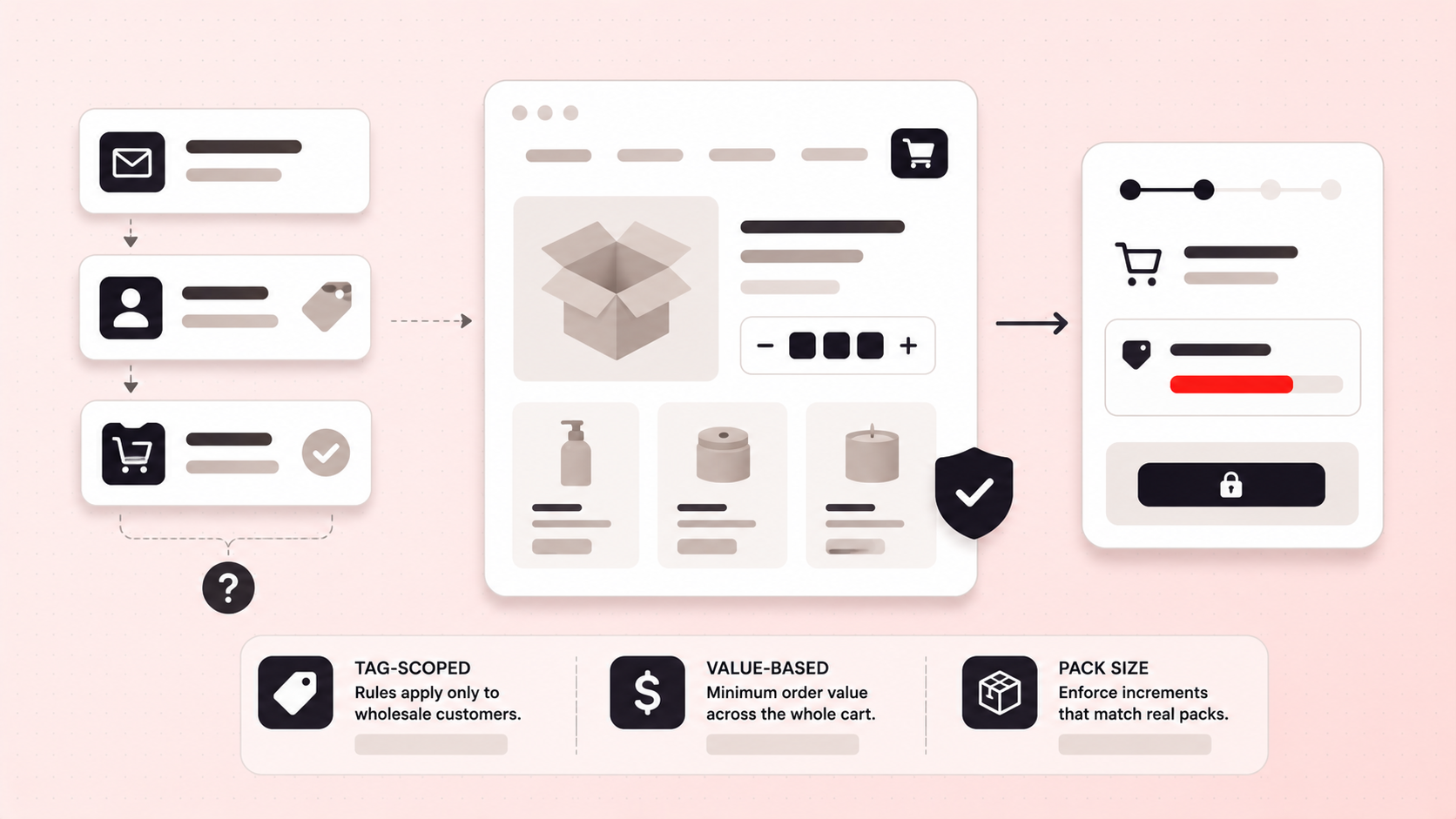
What you want is a rule that reads the customer, not the catalog. Three decisions make it work:
Scope by tag, not by product. A $250 floor applied to everyone punishes the retail shopper buying one candle. Applied to a
wholesaletag, it is invisible to them.Use value, not units, for the floor. A wholesale buyer reaching $250 across a mixed order is a better outcome than forcing twelve of one line. We compared the two in minimum order quantity or minimum order value.
Add increments where packaging demands it. Cartons are physical facts, and a value floor does nothing to protect them. That is a separate rule, covered in selling in case packs.
It has to hold at checkout, not on the page
Wholesale buyers are repeat, deliberate purchasers. They learn your storefront, and a rule that lives in your theme is one they will step around without meaning to, by editing the cart or using Buy Now.
Shopify's cart and checkout validation documentation is direct about the difference: validation functions "run on Shopify's servers and can block checkout progress when business rules aren't met," giving enforcement that "can't be bypassed by customers." Since 31 January 2024, "merchants on any plan can now use validation functions provided by public apps distributed through the Shopify App Store."
That last point is the one worth holding on to: the enforcement layer is not what B2B gates. The catalog is.
What you genuinely give up
Being honest about the gap matters more than selling a workaround:
Volume pricing. Shopify's B2B catalogs pair quantity rules with volume pricing, so a buyer sees a lower unit price at higher quantities. A tag-scoped limit does not give you tiered prices.
Company accounts. Multiple buyers under one company, with separate locations and payment terms, is a B2B construct. Tags model a person, not an organisation.
Native display. B2B themes can surface rules through the quantity_rule Liquid object. Outside that, whatever you use has to render the message itself.
If your wholesale business needs tiered pricing and company hierarchies, the plan is the answer and no app substitutes for it. If it needs a floor, a pack size and a polite message to the right customers, that is a rule problem, and it is solvable where you are.