
Why wholesale merchants use Prime MOQ
Wholesale and B2B accounts often need an order to meet a minimum before it is worth fulfilling. Packing, freight and account-management costs do not scale down for a 20 order the way they do for a 2,000 one. Prime MOQ enforces that minimum at checkout rather than describing it on a policy page.
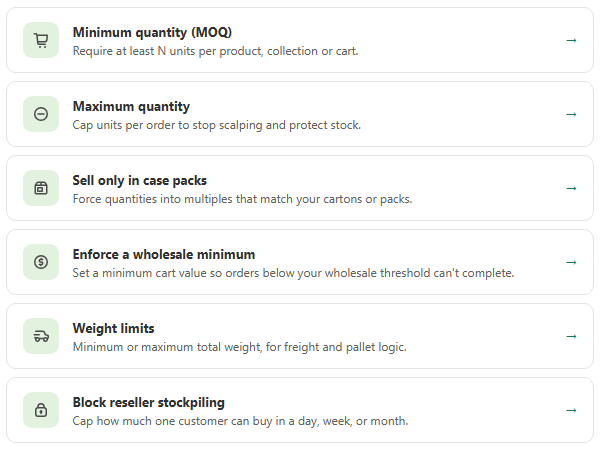
Reading path
Step | Article |
|---|---|
1 | Order Value Rules, to set a minimum cart value |
2 | Customer Eligibility, to scope it to a wholesale tag or segment |
3 | Case Packs and Multiples, if you also sell in cartons or set quantities |
4 | Scheduling a Rule, if the minimum only applies during a promo or after a trial window |
A typical B2B minimum-order rule
Limit type: Value
Minimum total value: your account minimum, for example 500
Applied products: All store, or a wholesale-only collection
Customer eligibility: Specific customer tags,
wholesaleHow to count: Combined total, so the whole matching cart is added together rather than checked product by product
Set up this way, retail shoppers checking out normally never see the message. It only appears for tagged wholesale accounts.
Pairing with discounts
Prime MOQ enforces the floor. It does not apply pricing. If you also run volume-based wholesale pricing, such as 10 or more units at a lower unit price, that is a job for Discount Prime, built by the same team and aware of your MOQ rules so the two do not conflict.