
Why manufacturers and distributors use Prime MOQ
If you manufacture or distribute physical goods, your constraints are often set upstream of your Shopify store entirely. A product only ships in cartons of a fixed size, or a pallet only makes financial sense past a certain total weight. Prime MOQ lets the storefront enforce those real-world packing and freight constraints instead of relying on customers to read a note in the product description.
Reading path
Step | Article |
|---|---|
1 | Case Packs and Multiples, to force orders into carton-sized multiples |
2 | Weight-Based Order Limits, for freight and pallet logic |
3 | How to Count, to decide whether each SKU must independently meet the pack size |
4 | Targeting Products, to apply different pack sizes to different product lines |
A typical case-pack rule
For a product line sold only in cartons of 12:
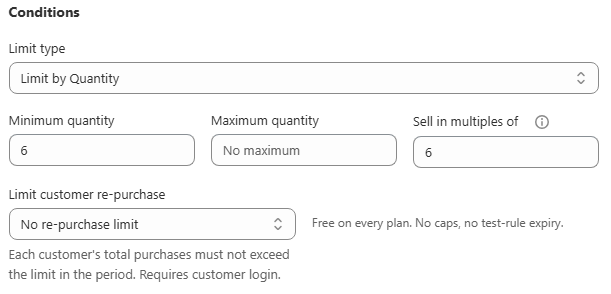
Limit type: Quantity
Sell in multiples of: 12
Applied products: the collection or product type covering that line
How to count: Each item separately, so every product in the collection must independently be ordered in a multiple of 12. Use Combined total instead if any mix of SKUs from the collection can add up to 12.
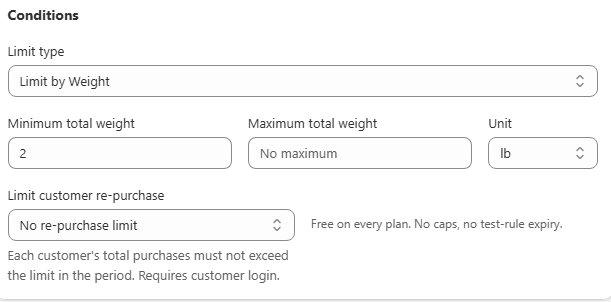
A weight-based freight rule would instead cap Maximum total weight across a heavy-goods collection, so a single order never exceeds what a standard shipment can carry.
Multiple constraints, one rule each
A product belongs to one rule at a time, so if a product line has both a case-pack requirement and a weight cap, decide which one actually governs. That is usually weight, since it is the harder physical constraint. Enforce the other through your variant setup, for example by only selling that item as fixed-size carton variants. See Why Only One Rule Applies Per Product.