
Prime MOQ

Per-customer limits

Repurchase Limits, Capping Purchases Per Customer

Cap how many units one customer can buy in total across separate orders, over a rolling day, week or 30 days. The rule that stops reseller stockpiling.

Prime MOQ Team

Prime MOQ Team

Updated ยท 2 min read

Short answer

A repurchase limit caps how many units of matching products one customer can buy in total across separate orders, over a rolling day, week or 30 days. It is the Limit customer re-purchase control in the Conditions card, it works with any limit type or alone, and it only applies to logged-in customers.

  • Repurchase is cumulative across orders in the period, unlike a per-order maximum.
  • It requires a logged-in customer. Guest checkouts have no history to check and are not enforced.
  • It reuses the Maximum quantity field. There is no separate cap field for repurchase.
  • The live Preview cannot simulate purchase history, so testing needs a real test account with real prior orders.

Before you start

  • Customer accounts enabled on your store

What it does

A repurchase limit caps how many units of matching products one customer can buy in total across separate orders, checked over a rolling period: per day, per week, or per 30 days.

It is the Limit customer re-purchase control in the Conditions card, and it is independent of the Quantity, Value and Weight limit type above it. It can be combined with any of them, or used entirely on its own.

GoalExample
Stop reseller stockpilingOne account buying 2 units today and 2 more tomorrow to bypass a per-order cap
Fair access on limited dropsCap total units per customer across the whole drop window, not just per order
Subscription-adjacent limitsPrevent re-ordering a consumable faster than realistically needed

How it works

Repurchase checks require the customer to be logged in at checkout. A guest checkout has no purchase history to check against, so a repurchase limit cannot be enforced for one.

The rule totals a customer's purchases of matching products within the chosen rolling period and blocks the order once that running total would exceed the cap.

Repurchase shares the same Maximum quantity field used by the Quantity limit type. There is no separate number field just for repurchase, so if you also set a per-order maximum, both are enforced from that one number.

Create the rule

Start from the quick-start tile, or from scratch. The Block reseller stockpiling tile opens a rule pre-filled with a maximum quantity of 2 and a 30-day repurchase period. Otherwise go to Rules > Create rule and set Maximum quantity to your per-customer cap.

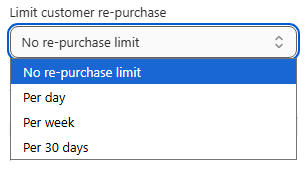
Set the repurchase period. In Limit customer re-purchase, choose Per day, Per week or Per 30 days.
Choose applied products. Scope the rule to the specific drop product or limited collection it applies to.

Save.

Verify it works

Because this depends on order history, testing means placing or already having real prior orders on a test account. The client-side Preview card cannot simulate purchase history, only the per-order Quantity, Value and Weight checks.

ScenarioExpected result
Customer's first order this period, 2 unitsAllowed, at the cap
Same customer orders 1 more unit inside the periodBlocked, the total would exceed the cap
A different customer, 2 unitsAllowed, limits are tracked per customer
Guest checkoutNot enforced, repurchase requires a logged-in customer

Common mistakes

  • The rule does not block a repeat order. Confirm the customer was actually logged in for both orders. Guest checkouts are not tracked.
  • Expecting it to behave like a per-order maximum. Repurchase is cumulative across orders in the period. Use a plain maximum quantity with no repurchase period if you only need to cap one order at a time.
  • Testing takes longer than expected. Results depend on when previous test orders were placed inside the rolling window, so use a dedicated test account.

Frequently asked questions

Does a repurchase limit work for guest checkouts?

No. It relies on a customer's order history, which only exists for a logged-in account. Guests are not blocked by a repurchase condition. If cross-order enforcement matters to you, requiring customer accounts at checkout is the only reliable route.

Is the period a rolling window or a calendar period?

Rolling. "Per 30 days" means the previous 30 days counted back from the moment of checkout, not a calendar month, so the cap frees up gradually as older orders age out of the window.

Where do I set the repurchase cap number?

In the Maximum quantity field. Repurchase has no separate cap field, so that one number is used for both the per-order maximum and the cross-order total when both are active.

Can I use a repurchase limit without any other condition?

Yes. Set Maximum quantity and a repurchase period and leave the rest of the conditions empty. The rule then only enforces a per-customer total over time.

Why can I not test this in the live Preview?

The Preview is a client-side simulation of a single cart with no backend calls, so it has no access to a customer's order history. Repurchase behaviour has to be tested with a real account and real prior orders.

Can I combine a repurchase limit with a case pack or a value rule?

Yes. Repurchase is independent of the limit type, so it layers on a Quantity, Value or Weight rule. Bear in mind that its cap is read from the Maximum quantity field, which is a unit count, whichever limit type the rest of the rule uses.

Best for: Limited drops, and any store fighting resellers who split purchases across several orders to get around a per-order cap.

Applies to: Logged-in customers only, Rolling day, week and 30-day periods

Did this answer your question?

Related articles

Still stuck?

Tell us what you are trying to set up and we will reply within 24 hours.

Contact support