
Prime MOQ

Choosing a limit

Which Limit Type Should I Use?

A decision guide and comparison table for picking between quantity, value, weight and repurchase limits, based on what is actually constraining you.

Prime MOQ Team

Prime MOQ Team

Updated · 1 min read

Short answer

Start from the constraint rather than the feature. A fixed carton size is a case-pack multiple. A money threshold is an order value rule. A shipping constraint is a weight rule. Anything else is a unit count, so use a minimum for a floor and a maximum for a ceiling. Add a repurchase period when the same customer keeps coming back.

  • Pick by what constrains you, not by the feature name.
  • Repurchase is not a limit type. It layers on top of whichever one you pick.
  • Only repurchase requires the customer to be logged in. Every other limit type works for guests.
  • The limit type is only one of three decisions. How to count and the product scope matter just as much.

Start from the constraint

What is actually constraining you?

Is it a fixed packaging or carton size?
├─ Yes → Quantity limit type, "Sell in multiples of"
│        (see Case Packs and Multiples)
│
└─ No → Is it a money threshold, a wholesale minimum or a spend cap?
         ├─ Yes → Value limit type, Minimum/Maximum total value
         │        (see Order Value Rules)
         │
         └─ No → Is it physical shipping weight, freight, pallets or LTL?
                  ├─ Yes → Weight limit type, Minimum/Maximum total weight
                  │        (see Weight-Based Order Limits)
                  │
                  └─ No → It is a unit-count constraint.
                           ├─ Need a floor?   → Quantity, Minimum quantity
                           └─ Need a ceiling? → Quantity, Maximum quantity

Separately: do you need to stop the SAME customer buying more across
MULTIPLE orders, not just one? Add "Limit customer re-purchase" to any of
the above. It is an independent control, not its own limit type.

Comparison table

Rule typeChecksBest forRequires login?
Minimum quantityUnit count, floorProtecting margin on small ordersNo
Maximum quantityUnit count, ceilingLimited drops, anti-bulk-buyingNo
Case pack or multipleUnit count, stepProducts that ship in fixed cartonsNo
Order valueCart money totalWholesale minimums, spend capsNo
Weight-basedCart total weightFreight and pallet-sensitive productsNo
Repurchase limitCumulative units over timeAnti-hoarding across separate ordersYes

Two more decisions every rule needs

Picking the limit type only sets the condition. Two more choices shape how it behaves.

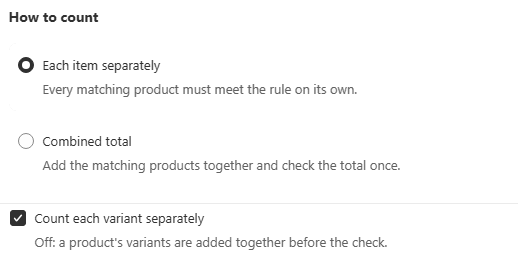
  1. How to count. Does the condition apply to each matching product independently, or to all of them added together? See How to Count.
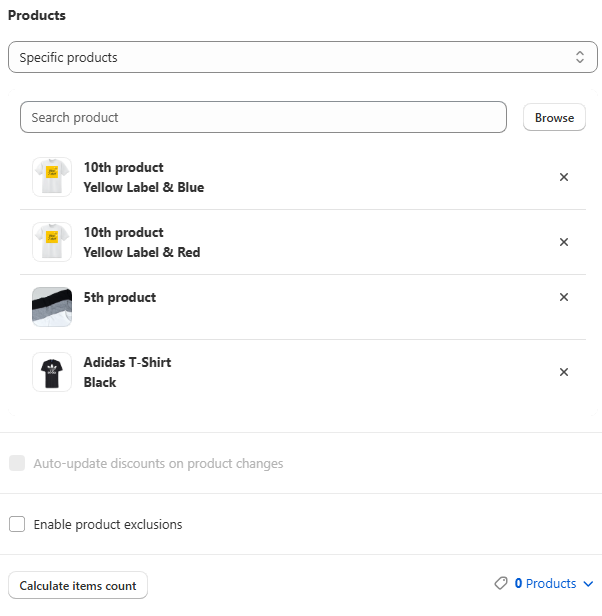
  2. Applied products (scope). Which products, collections, tags, vendors or product types the rule covers. See Targeting Products.
A rule with the right limit type but the wrong scope or counting mode is one of the most common reasons a rule does not behave as expected.

Not a rule-mechanics question?

If you are less sure which business scenario applies than which technical setting, follow the reading path that matches your store instead:

Frequently asked questions

What is the difference between a minimum quantity and a minimum order value?

A minimum quantity counts units, a minimum order value counts money. Quantity is more predictable because discounts do not change a unit count, while value is the right choice when your real constraint is the size of the order in money, such as a wholesale account minimum.

Should I use a maximum quantity or a repurchase limit?

A maximum quantity caps one order. A repurchase limit caps one customer across several orders in a rolling period. If a reseller can simply place a second order and defeat your cap, you need the repurchase limit, and you can use both together.

Can I use two limit types on the same product?

No. One rule governs a product at a time, and a rule has one limit type. Decide which constraint actually governs, usually the harder physical one, and express the other through your catalogue structure.

Which limit types work for guests who are not logged in?

Every one except repurchase. Quantity, value and weight rules are evaluated against the cart itself, so they apply to guest checkouts too. Repurchase needs an account's order history.

What if my constraint is a mix, such as a minimum and a case pack?

Use one Quantity rule with both fields. Minimum quantity and Sell in multiples of sit in the same limit type and enforce together.

Does picking the wrong limit type break anything?

No, it just enforces the wrong thing. Rules can be deactivated and edited at any time, and duplicating a rule is a safe way to try a different approach before switching the live one over.

Best for: Anyone deciding how to translate a real business constraint into a rule.

Applies to: Quantity, Value and Weight limit types

Did this answer your question?

Related articles

Still stuck?

Tell us what you are trying to set up and we will reply within 24 hours.

Contact support